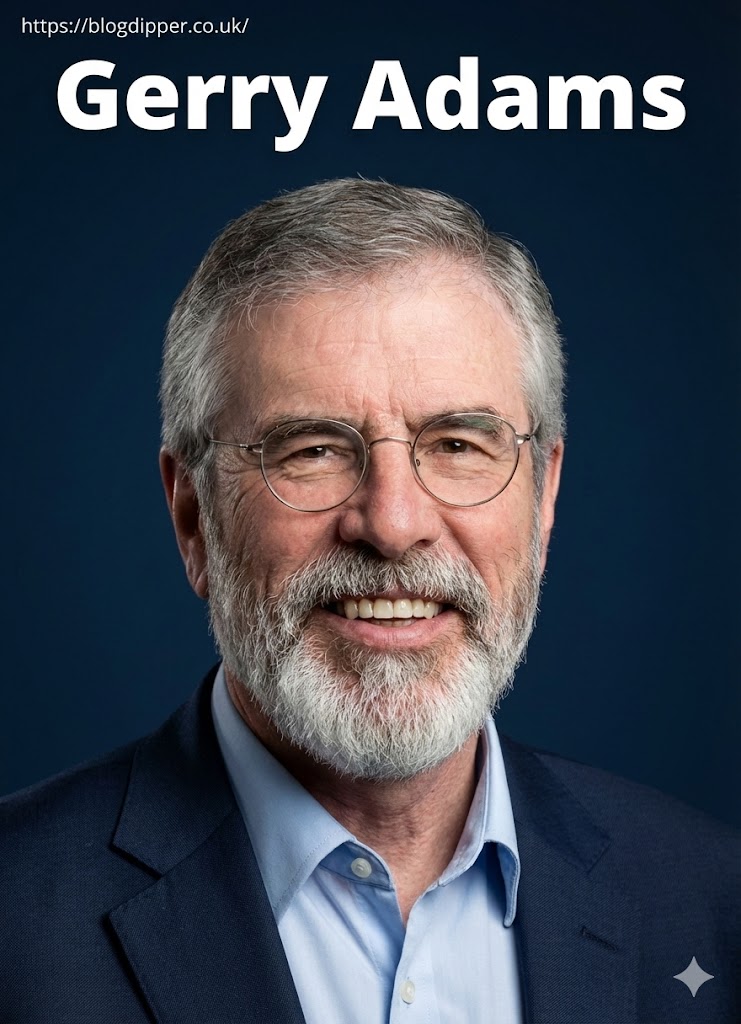
Gerry Adams is a name synonymous with the turbulent history of Northern Ireland, particularly during the period known as the Troubles. As a central figure in Irish republican politics, Adams has played a significant role in shaping the modern political landscape of Northern Ireland and Ireland, with a legacy marked by controversy, transformation, and, ultimately, the pursuit of peace.
From his early involvement with the Provisional Irish Republican Army (IRA) to his later years as the president of Sinn Féin, Gerry Adams’s career has been both divisive and transformative. In this article, we will explore his life, political journey, and the impact he has had on both the peace process and the contentious memory of the Irish Republican movement.
Early Life and Political Awakening
Born on October 6, 1948, in Belfast, Northern Ireland, Gerry Adams grew up in a working-class Irish-Catholic family. He became involved in politics at a young age, particularly in response to the civil rights movement in Northern Ireland and the escalating tensions between Protestant Unionists and Catholic Nationalists.
Adams’s early life was shaped by the Sectarian conflict that defined much of Northern Ireland’s history during the mid-20th century. His father, who had been involved in republican activities, instilled in him a sense of Irish nationalism, which would become the cornerstone of his political career.
As a young man, Adams was influenced by the civil rights struggles and the ongoing tensions that led to the outbreak of violence in Northern Ireland. He joined the Provisional IRA during the Troubles, a decision that would define much of his life in politics.
The Role of Gerry Adams in Sinn Féin
In the 1970s, as tensions in Northern Ireland reached a breaking point, Adams joined Sinn Féin, a political party that had strong links to the IRA. Sinn Féin advocated for the reunification of Ireland and the end of British rule in Northern Ireland. Adams quickly rose through the ranks of the party, becoming vice president in 1978 and then president in 1983.
Under his leadership, Sinn Féin made a strategic shift. While the party had previously been aligned with armed struggle, Adams sought to transition it into a political force, advocating for republican ideals through peaceful means and democratic processes. This shift was controversial and led to significant debate within both Sinn Féin and the broader Irish republican movement.
Adams’s strategy was successful in gaining widespread support for Sinn Féin, especially in Northern Ireland’s Catholic nationalist communities. His leadership helped make Sinn Féin the largest nationalist party in Northern Ireland, winning elections to the Northern Ireland Assembly and the Westminster Parliament.
The Peace Process and the Good Friday Agreement
Perhaps the most pivotal part of Gerry Adams’s legacy is his role in the peace process that ultimately led to the Good Friday Agreement of 1998.
For years, the conflict in Northern Ireland had been marked by violent confrontations between Catholic nationalists (who wanted a united Ireland) and Protestant unionists (who wanted to remain part of the UK). The violence of the Troubles had caused immense suffering and loss of life, and after years of failure to reach a lasting peace, Adams took a crucial step by engaging in peace talks with the British government.
Adams played an instrumental role in facilitating a ceasefire between the IRA and the British government in the mid-1990s. His efforts, alongside those of other key figures such as John Hume, Martin McGuinness, and David Trimble, helped bring about the Belfast Agreement (Good Friday Agreement), which marked a historic shift toward peace and political stability in Northern Ireland.
Through the agreement, paramilitary violence was officially renounced, and a new devolved government structure was established, giving nationalists a political voice while ensuring protections for the Protestant unionist community.
Controversy and Criticism
Despite his role in achieving peace, Gerry Adams’s legacy remains highly controversial. He has been accused of having links to the IRA during its violent campaigns, and while he has denied being a member of the IRA, many have questioned his role in the paramilitary organization.
Adams’s association with the IRA has led to accusations of hypocrisy from critics who argue that his involvement in the peace process should have been paired with full accountability for his past actions. Supporters, however, argue that his leadership helped move Sinn Féin away from violence and toward a future of peaceful political activism.
Adams’s reputation was further tarnished by accusations of involvement in the disappearance of Jean McConville, a woman allegedly murdered by the IRA in 1972. Although Adams has consistently denied any involvement, the case remains a point of contention in discussions about his legacy.
Gerry Adams in Recent Years
In recent years, Gerry Adams has stepped down from his leadership role in Sinn Féin, handing over the presidency to Mary Lou McDonald in 2018. He has continued to be involved in public life, advocating for Irish reunification and representing Sinn Féin in the Republic of Ireland’s Dáil Éireann (Irish parliament). He has also become an important figure in debates surrounding Brexit and its impact on Northern Ireland.
At 75 years old, Adams remains active in Irish and British politics, using his platform to speak about issues related to Irish nationalism, Northern Ireland’s future, and social justice. His legacy continues to be debated, but there is little doubt that his influence has had a profound effect on the history of both Northern Ireland and Ireland as a whole.
Personal Life and Family
Gerry Adams is married to Colette McArdle, and together they have three children. Adams has generally kept his family life private, but his wife and children have occasionally appeared in public alongside him during key moments in his political career.
Adams’s personal life has, however, been marked by tragedy. His brother, Liam Adams, was convicted of child abuse and sentenced to prison, a development that has caused personal pain for Gerry Adams.
Gerry Adams Today
Today, Gerry Adams continues to make headlines for his outspoken views on issues such as Irish unity, social justice, and Brexit. His ongoing involvement in Sinn Féin and his role in promoting peace in Northern Ireland cement his status as a key figure in Irish politics.
As Ireland moves into a new era, Adams’s legacy will continue to shape the national conversation, and his contributions to the peace process will be remembered for years to come.
Conclusion
Gerry Adams’s life and career have been defined by his controversial and transformative role in the Irish republican movement. From his early involvement with the IRA to his leadership of Sinn Féin and his pivotal role in the Good Friday Agreement, Adams has left an indelible mark on Irish and British politics.
While his legacy remains contested, particularly regarding his alleged role in the IRA and the Jean McConville case, there is no denying his role in shaping the modern political landscape of Ireland and Northern Ireland. His impact on the peace process has helped to bring an end to decades of violence, and his advocacy for Irish unity continues to inspire those who believe in a shared future for both parts of the island.
As Gerry Adams moves into his later years, his legacy will continue to evolve, but his place in the history of Ireland is firmly secured. Whether viewed as a hero, a villain, or something in between, Gerry Adams’s story is one of deep complexity, shaped by a tumultuous past and a commitment to the future of his country.